
PROTOCOL OVERVIEW
CREDA is a trust enforcement protocol for regulated systems.
CREDA enables continuous enforcement of identity, credentials, and authorization — not just at onboarding.
Most systems grant trust once and review it later. CREDA treats trust as infrastructure that must remain valid over time.
The Failure CREDA Corrects
In regulated systems today:
- Identity is verified at a point in time
- Credentials are issued as static artifacts
- Revocation occurs out-of-band
- Authorization assumes continued validity
This model fails silently — when credentials remain valid after they should not.
The CREDA Model
CREDA binds four elements into a single enforcement plane:
- Human identity (non-transferable)
- Credential state (live and attestable)
- Authorization scope (policy-governed)
- Revocation awareness (continuous)
Verification becomes deterministic at the system boundary. Access is conditional, not assumed.
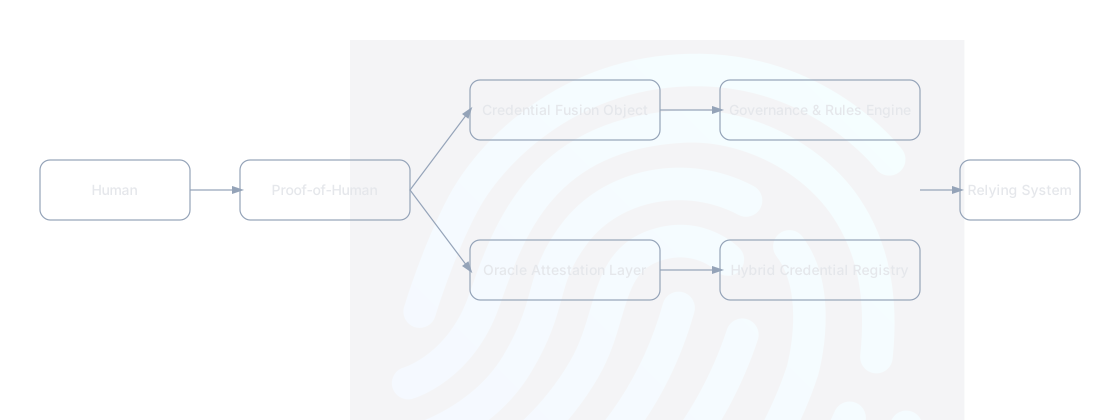
FIG. 1
CREDA Trust Enforcement Model
Conceptual representation of identity binding, credential state, policy evaluation, and revocation-aware authorization operating as a unified enforcement plane.
Protocol Primitives
Proof-of-Human (PoH)
Establishes a non-transferable binding between a verified human and an identity assertion that systems can independently verify over time.
Oracle Attestation Layer
Normalizes credential truth from authoritative sources into verifiable proofs.
Hybrid Credential Registry
Anchors credential state immutably while preserving privacy and jurisdictional control.
Credential Fusion Object (CFO)
A portable credential passport combining identity binding, attestations, and revocation state.
Governance & Rules Engine
Applies organizational, regulatory, and jurisdictional policy before authorization is granted.
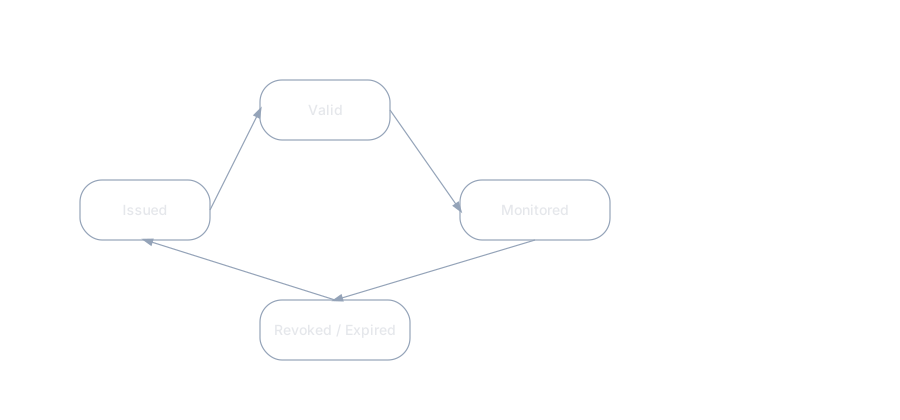
FIG. 2
Credential Lifecycle & Revocation Awareness
Illustrative lifecycle of credential issuance, validation, continuous monitoring, and revocation propagation.
What the Protocol Enables
- Continuous credential enforcement by consuming systems
- Real-time revocation visibility at authorization time
- Cross-organization and cross-jurisdiction portability
- Zero-knowledge selective disclosure
- Policy-driven authorization decisions
Trust becomes infrastructure — not workflow.
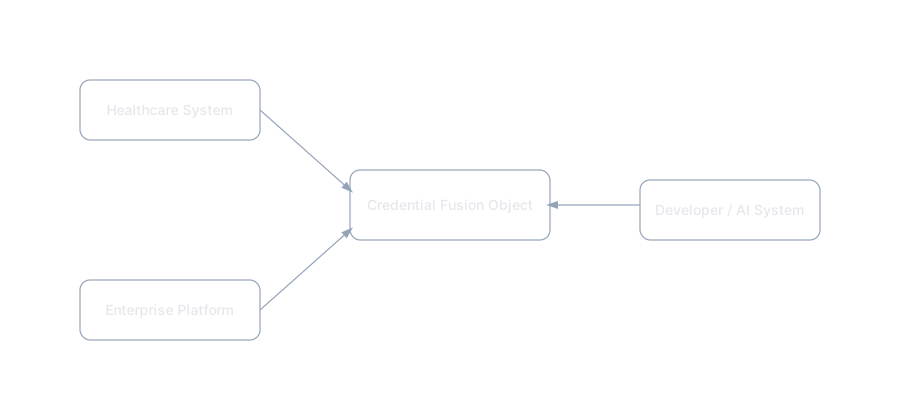
FIG. 3
Credential Portability Across Systems
Conceptual flow showing a portable credential being verified across organizational and jurisdictional boundaries.
Protocol Applications
CREDA is protocol-level infrastructure. Implementations include:
- Healthcare provider credentialing (CREDA1 reference implementation)
- Developer and AI system authorization (DevPass reference implementation)
- Enterprise and critical workforce authorization systems
The protocol remains constant. Only policy changes.
Status & Stewardship
The CREDA Protocol is the subject of filed U.S. patent applications covering identity-bound credentialing, oracle attestation, hybrid registries, revocation-aware verification, credential fusion, and governance enforcement.
CREDA is designed to remain infrastructure-neutral and does not require centralized custody, proprietary workflows, or platform lock-in.
This site describes protocol intent, not implementation detail.
Engagement
CREDA is engaging with grant programs, institutional partners, and advisors aligned with public trust infrastructure, regulated systems, and governance-first design.
The protocol is early. The problem is not.
For grant inquiries or advisory discussions: